



The way price tags work in retail has barely changed for decades,until now. Digital shelf edge labels (ESLs) are quietly rewriting the rules of store operations. This guide breaks down how these systems are actually built, what makes them tick, and why the architecture decisions made at implementation time matter far more than most buyers realize.
What is Digital Shelf Label
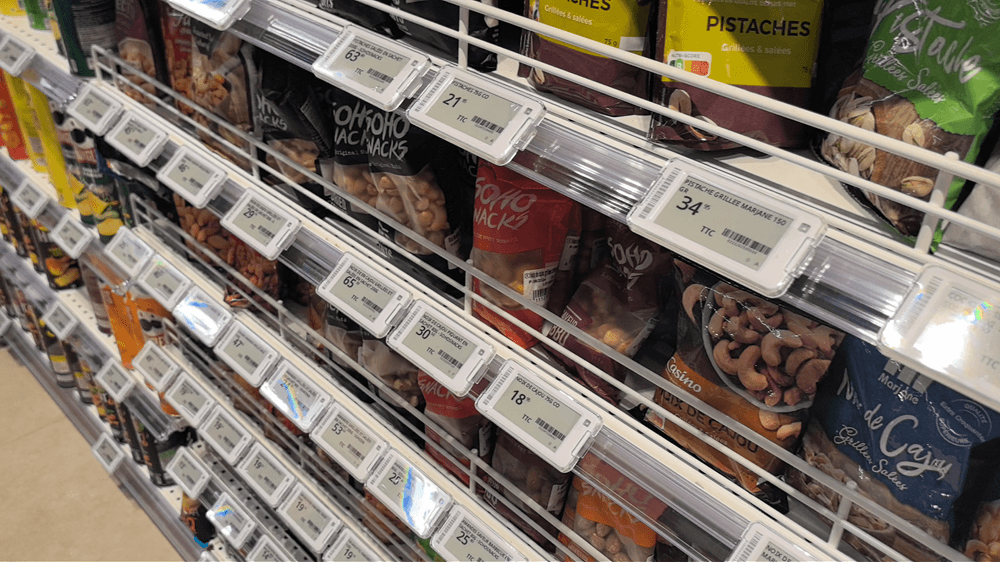
At their simplest, ESLs are small electronic displays, typically using e-paper or LCD technology, mounted at the shelf edge where a paper price tag would normally sit. They can be updated remotely, often across thousands of SKUs simultaneously, without anyone physically touching a single label.
But that description undersells the complexity. An ESL isn't just a screen. It's an endpoint in a wireless network, a data consumer connected to pricing and inventory systems, and increasingly a two-way communication device that can feed data back into store management platforms. The shelf edge has become infrastructure.
Core Components of the System Architecture
Understanding how ESL deployments are structured requires looking at each layer of the stack independently.
1. The Display Layer
The labels themselves come in a range of sizes, refresh rates, and communication protocols. E-paper displays are the dominant format for most grocery and general merchandise applications. They're low power, readable in direct light, and don't require continuous energy to hold an image. Some retailers use LCD panels for sections where video content or color accuracy matters more.
Each label has a unique hardware identifier, which is how the system knows which physical unit maps to which shelf position and SKU.
2. In-Store Communication Infrastructure
Labels communicate with the store network through one of several wireless protocols, most commonly 2.4GHz, sub-GHz radio frequencies, or Bluetooth Low Energy (BLE), with some systems using near-field or infrared communication for specific use cases. Access points or base stations are installed throughout the store ceiling to provide coverage.
The choice of protocol affects everything: update speed, battery life, range, and how many labels a single access point can manage. Sub-GHz systems tend to offer better penetration through shelving and racking but typically support fewer simultaneous devices per access point than 2.4GHz deployments. BLE has gained ground in recent years due to its extremely low power consumption and native compatibility with smartphones, useful for retailers exploring customer-facing proximity features,
3. The Store Server or Edge Computing Layer
Most enterprise ESL deployments include an on-premise server or edge computing node that handles label management at the store level. This intermediary layer does important work: it queues update requests, manages communication traffic to avoid network congestion, stores local copies of current label states, and ensures the system keeps functioning even during periods of upstream connectivity loss.
This edge layer is one area where architecture choices significantly affect operational reliability. Retailers that rely entirely on cloud connectivity without an on-premise buffer often experience update delays or failures during network outages.
4. Central Management Software
Above the store level sits a central management platform, either hosted on-premise at a retail head office or delivered as a cloud service. This is where pricing rules are set, promotions are scheduled, and label content is designed and approved.
The central platform typically integrates with the retailer's existing technology stack: ERP systems for product data and cost information, POS systems for price synchronization, and inventory management platforms that can trigger automated label updates when stock status changes.
5. Integration Middleware
The connective tissue between the ESL platform and existing retail systems is often underestimated in planning discussions. Clean, reliable integration with pricing engines, promotional management tools, and inventory systems is what transforms ESLs from a cost-saving display technology into an active part of retail operations.
Poorly designed integrations introduce latency, create synchronization errors between what the label displays and what the POS system charges, and limit the automation potential that makes ESL investment worthwhile in the first place.
Data Flow: How a Price Change Actually Happens
Walking through a typical price update illustrates how these layers work together.
A pricing manager updates a product price in the ERP system. The ESL integration layer detects this change, either through a real-time API call or a scheduled batch sync, and translates it into a label update instruction. That instruction travels to the central ESL management platform, which packages it and routes it to the relevant store server. The store server queues the update, schedules it within its communication cycle, and transmits the new price data to the appropriate label via the in-store wireless network. The label receives the update, refreshes its display, and sends an acknowledgment back through the same path.
Key Architecture Decisions That Determine Real-World Performance
Update Throughput and Prioritization
Stores with tens of thousands of labels face a real engineering challenge: how do you push updates to every label quickly when network bandwidth is finite? Systems need intelligent queuing that can prioritize urgent updates.
Fault Tolerance and Recovery
Labels that fail to receive an update shouldn't just sit frozen indefinitely. Good system architecture includes monitoring that flags unresponsive labels, retry logic for failed transmissions, and alerts that surface to store staff when labels need physical attention.
Security and Access Control
ESL systems are network endpoints. That means they require the same security considerations applied to any retail IoT deployment: encrypted communication, role-based access controls on the management platform, and network segmentation.
Scalability Across Formats
Retailers operating multiple store formats, hypermarkets, convenience stores, dark stores, need ESL architecture that can scale both up and down without requiring fundamentally different infrastructure in each format. This is an area where some legacy ESL platforms struggle; systems built around large-format deployment assumptions often don't adapt well to smaller footprints.
Where ESL Architecture Is Heading
The shelf edge is becoming a more active participant in retail operations rather than a passive display surface. Newer deployments use ESLs to show dynamic content beyond pricing: real-time stock availability, and pick-to-light functionality for fulfillment operations.
Computer vision integration is another direction gaining traction. Shelf cameras paired with ESL infrastructure can detect out-of-stock conditions automatically and update labels to reflect unavailability before a customer picks up an empty shelf gap as a service failure.
These capabilities don't change the fundamental architecture. The same layers that handle price updates can carry richer data payloads, as long as the network, edge computing, and integration layers were designed with that headroom in mind.
Practical Implications for Retailers Evaluating ESL Systems
Technology selection processes often focus on the label hardware, display quality, battery life, durability. These matter, but the architecture surrounding the labels determines whether the system delivers operational value at scale.
Before committing to any ESL platform, it's worth understanding how the system handles network outages, what the realistic update throughput is across a full store estate, how integrations with existing ERP and POS systems are structured, and what the vendor's approach to long-term platform development looks like. ESL deployments are long-cycle infrastructure investments. The architecture needs to support not just current requirements but the operational models retailers will be running five years from now.
The shelf edge is no longer a static information surface. Treating its architecture accordingly is where the real competitive advantage lies.
Why Retailers Choose Minewtag
Minewtag is a global provider of BLE-based electronic shelf label solutions, serving retailers across grocery, pharmacy, apparel, electronics, and specialty formats.
Hardware built for real retail environments. Minewtag's label lineup spans 1.5" to 31.5", covering shelf edge tags, large-format promotional displays, LCD shelf display for high-refresh applications, and wide strip screens for shelf-rail mounting. Display options include standard two-color e-paper through to four-color and six-color variants, giving visual merchandising teams the flexibility to communicate more than just price.
BLE architecture designed for scale. Built on Bluetooth Low Energy, Minewtag's communication layer delivers reliable, low-power label updates across store environments. BLE's native compatibility with modern retail infrastructure and mobile devices also opens the door to customer-facing applications as store operations evolve.
Integration that works with what you already have, connects to existing ERP, POS, and inventory management systems.
Contact our team and see how Minewtag's architecture holds up against the challenges that matter most to your operations.


