



Retail software holds plenty of information. Getting that information to the right place in a physical store takes more work.
Bluetooth Low Energy, usually shortened to BLE, handles part of that connection. It carries small amounts of data between compatible devices using relatively little power. Retailers use it in electronic shelf labels, tracking tags, temperature sensors, and some location-based services.
BLE supplies the wireless link. The useful work happens when store software turns those messages into a price update, directions, or an alert that someone can act on.
Why stores use BLE
Many devices in a store have modest communication needs.
BLE suits these short exchanges. Devices can spend much of their time in a low-power state rather than maintaining a continuous connection. That makes battery operation practical in places where running power cables would be inconvenient.
The arrangement varies by application. Shelf labels typically communicate through compatible gateways and management software. A customer’s phone might detect Bluetooth signals through a store app. Asset-tracking systems use receivers to register nearby tags.
Battery life and coverage depend on the hardware and settings, so retailers need to evaluate them against actual store conditions. A sensor inside refrigerated storage has a different workload and environment from a label on a dry-goods shelf.
Keeping shelf prices up to date
Routine price changes create more work than the number on the label suggests. Employees print replacements, sort them, walk the aisles, and match each label to its product. If a tag gets missed, the discrepancy may surface at checkout.
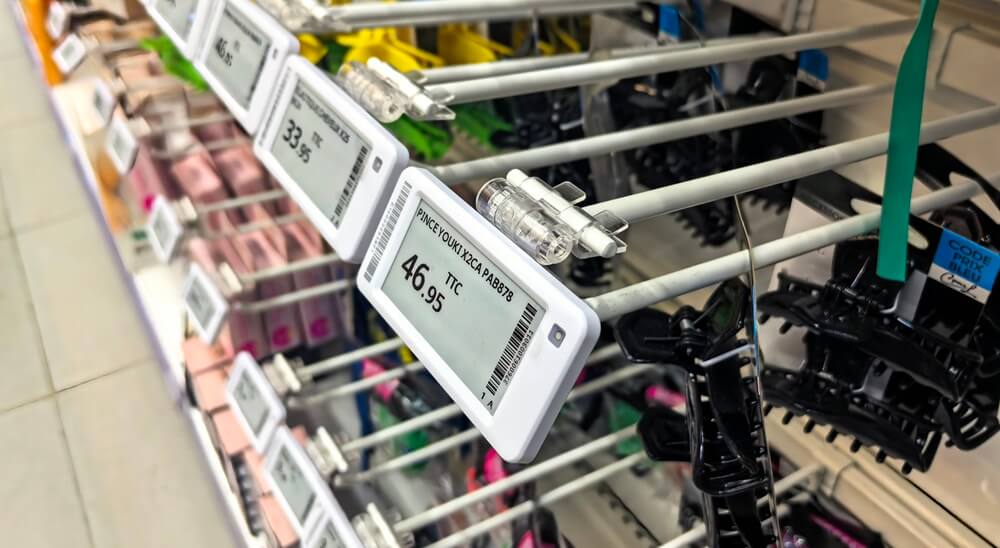
BLE electronic shelf labels move much of that process into the store's management system. Staff can send approved changes to the assigned displays and check which updates have gone through.
MinewTag's wireless price labels, for example, combine Bluetooth communication with e-paper displays. Used with a compatible gateway and platform, they support remote updates to shelf information. Different screen sizes accommodate different amounts of product and pricing content.
For a store team, the immediate benefit is fewer paper labels to handle. The underlying product records still need to be correct, and each display needs the right assignment. Once those connections are established, an ordinary price adjustment involves much less walking.
Giving customers useful directions
Finding a product can be surprisingly difficult even when a shopper knows exactly what to buy. Hardware stores are an obvious example. A customer looking for a particular fitting may recognize its photograph immediately and still have no idea which aisle contains it.
Bluetooth signals can contribute to indoor positioning through a compatible store app. The app combines location estimates with a floor map and product-location records to guide the customer.
The guidance might identify a department or aisle. Greater precision requires a system designed and installed for that purpose. A basic transmitter near an entrance cannot provide shelf-level directions throughout a building.
There is also a less technical issue: merchandise moves. Seasonal displays change, departments get rearranged, and products acquire secondary locations. Someone has to keep those records current. A well-maintained map is as important to the shopper as the wireless signal behind the blue dot.
Sending offers people have a reason to open
Location-based marketing was an early attraction of Bluetooth in retail. A store could recognize that an app user was near a particular department and show a relevant offer.
That remains a possible use, provided the app supports it and the customer grants the necessary permissions. Someone shopping for outdoor furniture might appreciate a discount on cushions. A pickup reminder near the collection counter could be more useful still.
The retailer has to exercise restraint. Walking past a display is a weak signal of interest, and several notifications during one visit can quickly become irritating.
A sensible approach gives shoppers control over what they receive. Location access should come with a clear explanation of its purpose. The offer itself should justify the interruption. BLE provides proximity information; deciding when that information warrants a message is a merchandising and customer-experience decision.
Locating the scanner everyone shares
A missing mobile printer rarely makes a technology strategy presentation. It can still hold up a shift.
Shared equipment travels. One employee takes a scanner to receiving, another borrows it for a stock check, and the next team starts searching. Attaching a BLE tag gives a compatible tracking system a way to register where that equipment was detected.
Depending on receiver coverage, employees may see an approximate area or the asset's last recorded location. Even a department-level indication can narrow a search.
The same approach can apply to reusable containers or carts used for fulfillment. A tagged container can be associated with an order in store software, helping staff locate it when the customer arrives.
That association deserves attention. The tag identifies the container; the order record identifies what should be inside. Scanning and inventory procedures keep the two connected.
Checking refrigerated storage between inspections
Temperature monitoring puts BLE into a different kind of daily routine.
A wireless sensor takes readings inside a refrigerator or storage area and sends them through a compatible gateway. Monitoring software compares the readings with configured limits. If a temperature moves outside the expected range, staff can receive an alert.
An employee can then check for an open door, a blocked vent, or an equipment problem. The record also gives the team something more useful than a single reading taken after the issue was discovered.
Sensor selection and placement require care. Temperatures vary within a cabinet, and the hardware must suit the operating environment. Stores also need to decide who receives alerts during each shift. A warning sent to an unattended account does little for the food in the refrigerator.
Reading shopper movement with care
Some BLE deployments also contribute location data for store analysis. With appropriate permissions and a supported app, retailers can examine how participating customers move between areas or where they spend time.
These observations can raise useful questions about a layout. Customers repeatedly backtracking near a department might be struggling with signs. A display receiving little attention may deserve a closer look.
The interpretation is less certain than the location record. A customer standing near a product could be comparing prices, answering a text, or waiting for someone. App users also represent a particular sample of shoppers.
Managers get more from these records when they compare them with sales and what employees observe on the floor.
Conclusion
When evaluating a BLE-based retail system, follow one piece of information all the way through the store. Where does it originate, how does it reach the device or employee, and what happens next? That exercise reveals whether the proposed system will improve the work or merely add another connection to maintain.


